

Key Takeaways
- Publishing multiple blogs in one day isn’t penalized, but it weakens how each post performs and gets discovered.
- Limited crawl capacity means some posts may not get indexed quickly, reducing their chances of ranking.
- Flooding your audience with content leads to lower engagement, missed reads, and higher unsubscribe risk.
- Publishing in bulk makes your content compete with itself instead of building momentum.
- Quality drops when speed becomes the priority, and weaker posts can impact overall site credibility.
- Internal linking opportunities are lost when everything goes live at once, breaking content structure.
- Consistency over time builds authority, while bulk publishing signals poor strategy.
- The most effective approach is to space out content, promote each post individually, and build topical depth gradually.
You’ve got ten blog posts written. They’re polished, they’re relevant, and you’re eager to get them live. So why not just publish them all today?
It feels productive. But before you hit publish ten times in a row, you need to understand what actually happens – to your SEO, your audience, your crawl budget, and your site’s long-term credibility.
This isn’t about being cautious for the sake of it. It’s about protecting the work you’ve already put in.
First, Let’s Be Clear: It’s Not a Crime
Google doesn’t penalize you for publishing multiple posts in one day. There’s no rule against it, and no manual action will hit your site just because you uploaded ten articles at once.
But just because something isn’t penalized doesn’t mean it’s smart. The consequences are more subtle – and often more damaging – than a direct penalty.
Here’s What Actually Happens
Publishing 10 blogs in a single day triggers a ripple effect across several areas of your website’s performance. Here’s the full picture:
| Area | Short-Term Effect | Long-Term Effect |
|---|---|---|
| Google Crawling | Crawl budget may get split | Some pages may not get indexed |
| Content Quality | Appears rushed or thin | High bounce rate, low dwell time |
| Audience Trust | Confusion or overwhelm | Unsubscribes or disengagement |
| Social Sharing | Posts compete with each other | Lower per-post reach |
| SEO Authority | No immediate boost | Diluted topical relevance |
The Crawl Budget Problem (And Why Small Sites Feel It Most)
Every website gets a crawl budget – the number of pages Google will crawl within a given timeframe. For newer or smaller sites, this budget is limited.
When you suddenly publish 10 new pages, Googlebot has to decide which ones to prioritize. It can’t always crawl all of them quickly, which means some of your posts may sit unindexed for days or even weeks.
Google has also clarified that not all pages get indexed, even if they are crawled, meaning publishing more pages at once does not guarantee visibility.
This is also why some pages briefly rank and then disappear, a pattern explained in detail in Why New Websites Rank Briefly Then Disappear.
| Site Size | Crawl Budget Reality |
|---|---|
| Small site (under 100 pages) | Google may crawl only a few pages per day – 10 new posts can overwhelm this |
| Medium site (100-1,000 pages) | Better capacity, but new pages still compete for crawl slots |
| Large/established site | More crawl budget available, but content quality still determines indexing speed |
Google doesn’t index all the pages that it crawls.
John Mueller, Senior Search Analyst / Search Relations Team Lead
The fix isn’t to panic – it’s to publish strategically so every new page gets the attention it deserves from search engines.
What It Does to Your Audience
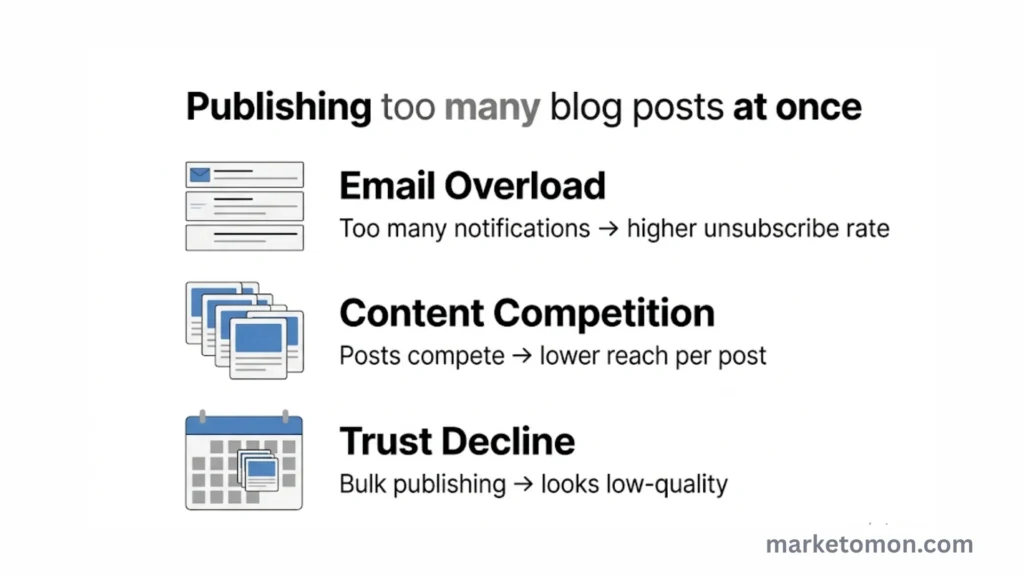
Your subscribers, followers, and regular readers are humans – not algorithms. Flooding them with ten posts in a single day creates a very specific set of problems.
Email Subscribers Get Overwhelmed
If you send email notifications for new posts, ten emails in one day is almost guaranteed to produce unsubscribes. Even engaged readers have limits. Studies consistently show that sudden spikes in email frequency lead to higher unsubscribe rates, especially when content is delivered in bulk rather than paced.
Social Promotion Becomes Impossible
You can’t effectively promote ten posts on the same day. Each post ends up competing with the others for attention, and none of them gets the focus it needs to gain traction.
Trust Signals Go Down
When readers see ten posts all dated the same day, it raises a flag. It looks like a content dump – not a serious publication. Even if the writing is great, the perception problem is real.
The Content Quality Trap
Here’s the harder truth: if you’re publishing ten posts in one day, at least some of them probably aren’t as strong as they could be.
Great blog content takes time – not just to write, but to fact-check, edit, format, internally link, and optimize. When quantity becomes the goal, quality quietly slips.
Thin content, shallow coverage, or poor on-page SEO across multiple posts can drag down your site’s overall quality score in Google’s eyes. One strong post beats ten mediocre ones every single time.
Backlinko’s analysis of 11.8 million Google search results also found that longer, in-depth content tends to rank higher, reinforcing that depth and usefulness outperform volume.
Poorly structured or rushed content can also lead to ranking for irrelevant queries, something many site owners struggle with.
How It Affects Your Internal Linking
Internal links are one of the most underrated SEO tools available. They help Google understand your site structure, distribute page authority, and guide readers to related content.
When you publish ten posts at once, none of them can link to the others because they didn’t exist when you were writing. You miss the chance to build a natural, connected content web – and that’s a real loss for both SEO and user experience.
Compare that to a staggered approach: publish one post, then reference it in the next, then the next. You’re building architecture, not just filling space.
Smart Publishing: What the Numbers Actually Support
Research from multiple SEO studies consistently shows that frequency matters less than consistency and quality. Here’s how different publishing schedules stack up in terms of realistic outcomes:
| Frequency | Best For | Pros | Risk |
|---|---|---|---|
| 1 post/week | New sites, solo bloggers | Quality focus, consistent | Slower traffic growth |
| 3 posts/week | Growing blogs, small teams | Good balance of volume & quality | Moderate resource demand |
| 5 posts/week | Established content teams | Fast authority building | Quality control harder |
| 10 in 1 day | Almost no scenario | Quick content dump | SEO, trust, and quality risks |
Data support this approach. HubSpot reports that companies publishing 16+ blog posts per month generate around 3.5x more traffic than those publishing 0–4, but the key driver is consistency over time, not bulk publishing in a single day.
The One Exception Worth Knowing
There are a small number of situations where publishing many posts at once makes sense. They’re rare, but they’re real:
| Scenario | Why It Might Work |
|---|---|
| Migrating old content from another platform | Articles already indexed elsewhere – you’re reclaiming them, not launching fresh |
| Site relaunch after redesign | Google already knows these URLs – re-publishing is expected |
| Pre-scheduled batch for a campaign | If posts are spread over days via scheduling tools, this is fine |
Notice what’s missing from that list: “I wrote a lot this week” or “I want to grow faster.” Those aren’t valid reasons – they’re impulses.
What You Should Do Instead
If you have ten posts ready to go, you’re actually in a great position. Here’s how to use that content library wisely:
- Schedule posts across 2-4 weeks to maintain consistency without overloading Google or your audience
- Use the first post to internally link to where future posts will live, then update those links as you publish
- Promote each post individually on social media, giving each one its own moment
- Send one email newsletter per week, highlighting your latest post – not one per post
- Use tools like Yoast SEO or Rank Math to ensure every post is properly optimized before it goes live
- Submit your sitemap to Google Search Console after each new publish to speed up indexing
Also Read: How to Find Your Website’s Cannibalized Keywords Without Paid Tools
A Note on Topical Authority
One of the most powerful SEO strategies right now is building topical authority – becoming the go-to resource on a specific subject through a cluster of deeply connected content.
Publishing ten posts on the same topic in one day doesn’t build topical authority. It signals to Google that you’re spraying content rather than building expertise.
A better approach: publish one cornerstone piece, then release supporting posts one at a time over several weeks, each linking back to the cornerstone. That’s how topical authority gets built – methodically, not in bulk.
The Bottom Line
Publishing ten blog posts in one day isn’t a strategy – it’s a shortcut that often backfires. The SEO risks, audience trust issues, internal linking gaps, and content quality problems far outweigh the short-term feeling of productivity.
The websites that win in search aren’t the ones that publish the most in a single day. They’re the ones that published consistently, strategically, and with genuine value in every post.
You’ve already done the hard work of writing ten posts. Now do the smart work of publishing them the right way.
Related Read: Canva Marketing Strategy