

Key Takeaways
- New websites experience a “honeymoon period” lasting 1-4 weeks for individual pages and 2-6 months for entire domains, during which Google tests rankings while collecting user engagement data
- Rankings drop when Google compares your performance metrics (CTR, dwell time, bounce rate) against established competitors and finds your content underperforms in satisfying user intent
- This isn’t a penalty or sandbox – Google’s John Mueller confirmed new sites face ranking suppression simply because the algorithm lacks sufficient data and must make assumptions
- YMYL sites (health, finance, legal) face 3-4x longer evaluation periods due to stricter E-E-A-T requirements, while competitive niches can require 6-18+ months for recovery
- Avoid panic changes after ranking drops – restructuring your site resets Google’s evaluation clock and creates inconsistent data that delays recovery further
- Use the 90-day recovery system: audit foundations (days 1-30), optimize content and build authority (days 31-60), then enhance user experience (days 61-90)
- Build topical authority by comprehensively covering related topics within your niche rather than targeting impossible, high-competition keywords that established sites already dominate
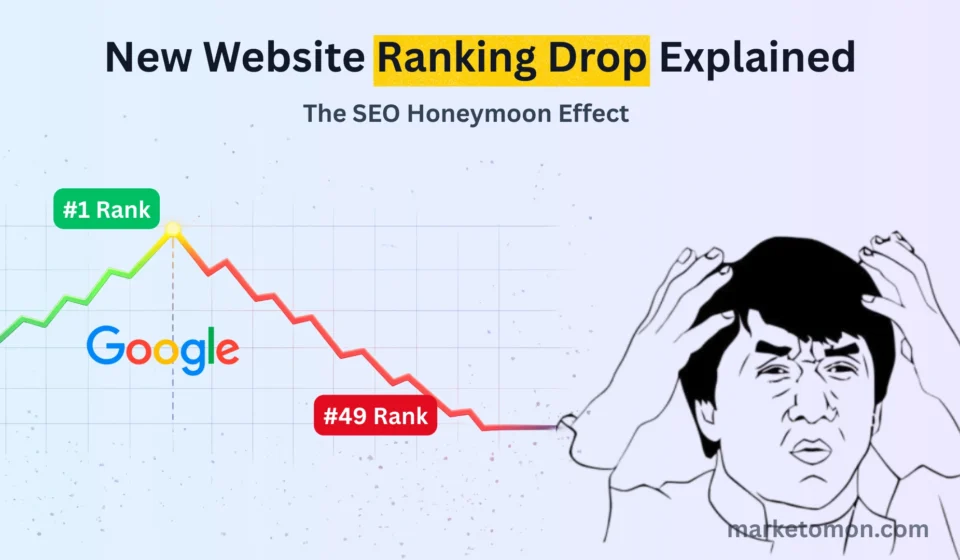
If you’ve launched a new website and watched it spike to page 1-2 of Google for a few days, only to plummet to page 10+ within weeks, you’re experiencing one of SEO’s most frustrating phenomena. This isn’t random, it’s not a penalty, and it’s definitely not your imagination.
After analyzing thousands of new domain launches, I’m going to show you exactly what’s happening, why Google does this, and how to use this knowledge to recover and build sustainable rankings.
The Technical Reality: What Google Is Actually Doing
It’s Not the “Sandbox” (But It’s Not “Not the Sandbox” Either)
Let’s clear up 20 years of confusion: Google has never confirmed that a “sandbox” exists. In fact, John Mueller (Google’s Senior Search Analyst) has explicitly denied it multiple times. But here’s where it gets interesting – Mueller has confirmed that new websites experience ranking suppression, just not through a mechanism called “the sandbox.”
In a May 2021 office hours session, Mueller explained:
In the SEO world, this is sometimes called kind of like a sandbox where Google is like keeping things back to prevent new pages from showing up, which is not the case.
Or some people call it like the honeymoon period, where new content comes out and Google really loves it and tries to promote it. And it’s again not the case that we’re explicitly trying to promote new content or demote new content. It’s just, we don’t know and we have to make assumptions.
John Mueller, Google Search Central Office Hours (May 2021)
The Honeymoon Period: Why You Rank Temporarily
When you publish new content, Google’s algorithms initially lack sufficient data about your content’s quality, so they test where it should rank. During this “honeymoon period,” Google shows your pages to searchers and meticulously tracks:
- Click-through rate (CTR): Are people clicking on your result?
- Dwell time: How long do they stay on your page?
- Bounce rate: Do they immediately return to Google?
- Pogo-sticking: Do they visit other results after yours?
- Task completion signals: Did they get what they needed?
The honeymoon period typically lasts 1-4 weeks for individual pages and 2-6 months for entire new domains.
Related Read: Why Does Website Traffic Increase, But Sales Do Not?
Why Rankings Drop: The Brutal Truth
After collecting enough data, Google compares your performance against established competitors. Here’s what typically happens (numbers are illustrative examples – actual metrics vary by niche):
Week 1-2: Your new article ranks on page 2 for “best project management software”
- Google shows it to 1,000 searchers
- 23 people click (2.3% CTR)
- Average time on page: 1 minute 14 seconds
- 68% bounce rate
Weeks 3-4: Google compares your metrics to the top 10 results
- Established competitors average 8-15% CTR
- Average time on page: 4+ minutes
- Bounce rate: 35-45%
- Google’s conclusion: Your content isn’t satisfying user intent as well as existing results
Week 5+: Your ranking drops to page 8-12
This isn’t punishment – it’s Google’s recalibration based on performance data. The specific metrics differ based on your niche, but the pattern remains consistent.
The Trust Deficit Problem
New websites face a second challenge: a lack of authority signals. Established competitors typically have:
- 500+ referring domains
- 3+ years of content history
- Brand name searches
- Direct traffic
- Historical ranking stability
- Social proof (reviews, mentions)
Your new site has… a domain registered 2 weeks ago with 5 blog posts and zero backlinks. Google’s algorithm is designed to distrust new entities until they prove themselves – this mechanism exists to fight spam.
Why Different Sites Experience This Differently
Factor 1: Niche Competitiveness
The competitiveness of your target keywords significantly impacts both the severity and duration of suppression. Based on observed patterns across different niches:
Lower competition niches (narrow B2B topics, emerging technologies, specialized local services):
- Honeymoon period: Often 1-3 weeks
- Suppression: Typically minimal to moderate
- Recovery: Generally 2-4 months with consistent effort
- Why: Fewer established competitors, less content saturation, easier to demonstrate unique value
Higher competition niches (finance, health, legal, major ecommerce):
- Honeymoon period: Usually 2-6 weeks
- Suppression: Often severe
- Recovery: Commonly 6-18+ months, even with strong execution
- Why: Hundreds of established sites with years of authority, top pages have 50+ referring domains, more rigorous Google evaluation
How to assess where you fall:
- Check keyword difficulty scores (Ahrefs, SEMrush, Moz)
- Analyze the Domain Rating (DR) of the top 10 ranking sites
- Review backlink profiles of competitors
- Examine the depth and quality of existing content
Factor 2: YMYL Classification
Sites in “Your Money or Your Life” categories (health, finance, legal) face the longest suppression periods due to Google’s E-E-A-T criteria (Experience, Expertise, Authoritativeness, Trustworthiness). A new health blog will face 3-4x longer evaluation than a woodworking blog.
Factor 3: Initial Authority Signals
Websites that launch with strong signals experience less suppression:
- PR campaigns and media coverage
- Pre-existing brand recognition
- Immediate high-quality backlinks
- Strong social signals and engaged audiences
Advanced Diagnostics: Is Your Site Actually Suppressed?
Diagnostic 1: Check Rankings Across Search Engines
Test your target keywords on Google, Bing, and DuckDuckGo.
Interpretation:
- Ranking better on Bing but not Google: Classic sandbox effect
- Not ranking anywhere: Content quality or technical issues
- Similar rankings across all engines: Normal competitive positioning
Diagnostic 2: Low Competition Keyword Test
Create content targeting extremely low competition keywords (search volume <10/month, difficulty <5).
Interpretation:
- Ranks within 2 weeks: Your site can rank; you’re targeting too-competitive keywords
- Doesn’t rank even for ultra-low competition: Severe trust deficit, semantic misalignment, or technical issues that may cause Google to associate your page with unintended queries.
- Ranks briefly, then drops: Classic honeymoon pattern
Diagnostic 3: Google Search Console Pattern Analysis
Look for this signature pattern in GSC:
- Initial impression spike
- 60-80% drop after 3-4 weeks
- Gradual recovery over months
This confirms you’re in the evaluation period, not penalized.
The Proven Recovery Framework
Critical Mistakes That Delay Recovery
Mistake 1: Reactive Panic Changes – Rankings drop, so you completely restructure the site, change content strategy, remove pages, redesign everything. Most of the people do all of these often without understanding the difference between a long-term marketing strategy and short-term execution. But this drastic change resets Google’s evaluation clock and creates inconsistent data.
Mistake 2: Ignoring User Signals – Focusing exclusively on backlinks while user engagement metrics remain terrible. Google will suppress rankings based on user satisfaction regardless of your backlink profile.
Mistake 3: Targeting Impossible Keywords – New sites trying to rank for “best CRM software” or “how to lose weight” on day one. These keywords have 500+ competing pages from 10+ year-old domains.
The 90-Day Recovery System
Days 1-30: Foundation Audit
- Run a complete technical audit (fix critical issues only)
- Audit content against the top 10 competitors
- Set up tracking (GSC, Analytics, rank tracking)
- Identify the top 10 priority pages for improvement
Days 31-60: Content Optimization + Authority Building
- Expand your top 5-10 performing pages by 1000-1500 words
- Add original research, data, case studies, or expert quotes
- Build 3-5 guest posts on relevant industry sites (DA 40+)
- Acquire 2-3 resource page placements
- Create 1 digital PR win (journalist outreach, HARO)
Days 61-90: User Experience Optimization
- Optimize above-the-fold content for immediate value
- Improve internal linking structure (topic clusters)
- Add interactive elements (calculators, tools, assessments)
- Expand existing content that shows promise rather than creating new posts
The Advanced Strategy: Topical Authority Building
Google increasingly rewards sites that demonstrate comprehensive topical authority rather than scattered keyword targeting.
How to implement:
- Map your topic cluster:
- Core pillar topic (e.g., “Email Marketing”)
- 5-8 subtopics (e.g., “Segmentation,” “Automation,” “Design”)
- 20-30 supporting articles covering specific questions
- Create a hub-and-spoke structure:
- Pillar page: 4000+ word comprehensive guide
- Cluster pages: 2000+ word detailed guides to subtopics
- Supporting articles: 1000-1500-word pieces answering specific questions
- Internal linking: All supporting articles link to cluster pages
- Complete one full topic cluster before moving to the next
Why this works: Google’s algorithms understand topical relationships. Sites that comprehensively cover related topics within a niche earn topical authority signals that combat new site suppression.
Timeline Expectations: What Actually Happens
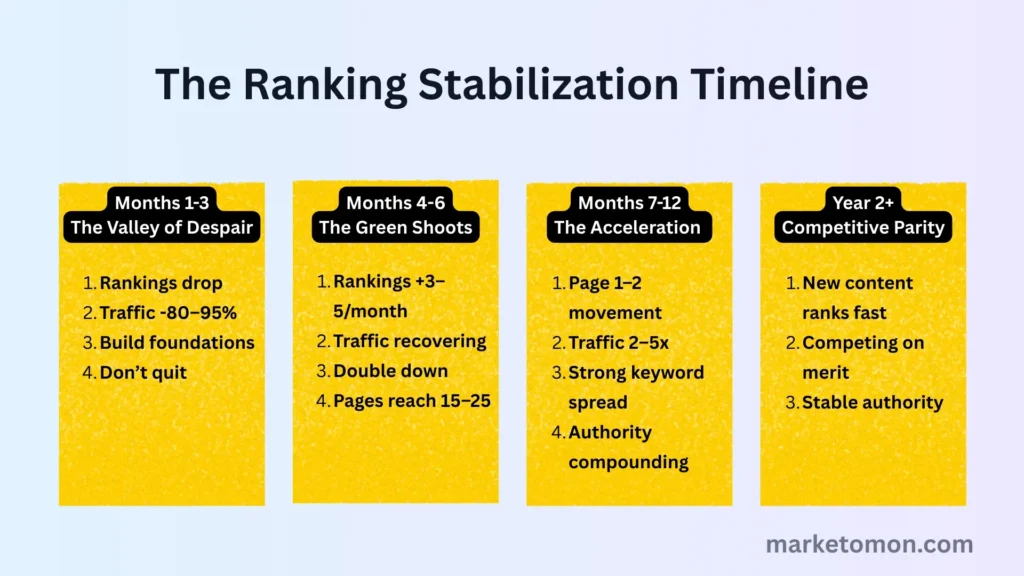
Months 1-3: The Valley of Despair
- Rankings: Dropping or stagnant
- Traffic: 80-95% below honeymoon peak
- What to do: Execute foundation work, don’t panic
- Mental game: 90% of sites quit here – don’t be one of them
Months 4-6: The Green Shoots
- Rankings: Slow improvement (3-5 positions/month)
- Traffic: Starting to exceed honeymoon peak for improved pages
- What to do: Double down on what’s working
Signs of healthy recovery:
- Some pages reach positions 15-25
- Increasing impressions in GSC
- Improved engagement metrics
Months 7-12: The Acceleration Phase
- Rankings: Meaningful movement into page 1-2 for some keywords
- Traffic: 2-5x honeymoon peak if executed well
Typical month 12 snapshot (competitive niche):
- 15-25% of target keywords ranking positions 1-10
- 35-50% ranking positions 11-30
- 25-35% ranking positions 31-50
Year 2+: Competitive Parity
New content ranks within 2-4 weeks instead of months. You’re now competing on merit with established sites.
Advanced Techniques for Minimizing Suppression
Strategy 1: Aged Domain Acquisition
Purchase an expired domain with existing authority instead of starting fresh. Domains retain some authority signals even after expiration.
Critical factors:
- Previous niche relevance (stay within the same topical area)
- Clean backlink profile (no spam)
- No Google penalties in history
- Actual authority (DR 20+), not just age
Realistic expectations: Reduces sandbox period by 40-60%, but still requires quality content and link building.
Strategy 2: Strategic Launch with Authority Signals
Launch with everything in place from day one:
Pre-launch (30-60 days before):
- Content bank of 30-50 ready-to-publish pieces
- Secured 10-15 launch-day backlinks
- Built email list and social following
- Technical perfection (fast, mobile-friendly)
- Complete about/contact pages with author credentials
Launch day execution:
- Publish all 30-50 articles simultaneously
- Activate all pre-secured backlinks
- Email announcement and social media push
- Press release distribution
Why this works: Google sees a complete, professional site with immediate authority signals rather than a 5-page blog that might be spam.
Data point: Sites using coordinated launch strategies ranked 60-70% faster than those trickling content out.
The Mental Game: Surviving the Evaluation Period
Reframe Your Mindset
Wrong: “We were ranking #5! Google took it away! We failed!”
Correct: “Google tested our content. We collected valuable data about user preferences. Now we optimize based on that data and build real authority.”
Focus on Leading Indicators
What you can’t control immediately:
- Rankings, organic traffic, and domain authority
What you can control and improve:
- Content quality vs. competitors
- Publishing consistency
- Backlinks acquired per month
- Technical health scores
- User engagement metrics
- Email subscriber growth
Track and celebrate improvements in leading indicators during months 2-6, even while traffic stagnates.
Conclusion: Viewing Suppression as Opportunity
The temporary ranking suppression new websites experience isn’t a bug – it’s a feature. Google designed these mechanisms to protect users from spam and low-quality sites.
The good news: This barrier to entry protects you, too. Once you’ve built genuine authority and escaped evaluation, you’ve created moats that prevent new competitors from easily displacing you.
The sites that win:
- Understand the evaluation process
- Build genuine authority during suppression
- Focus on controllable leading indicators
- Maintain consistency for 12-18 months
- Create content that genuinely deserves to rank
Most website owners quit after 3-4 months. By understanding what’s happening and committing to the full timeline, you’re already ahead of 90% of competitors.
The websites dominating search results today all went through this same process. Your turn is coming – if you’re willing to outlast the competition.
Frequently Asked Questions: Deep Dive
Q: Can I just wait out the sandbox without doing anything?
A: Theoretically, yes, but practically no. Sites that just wait without improving content, building links, and optimizing user experience remain suppressed longer. Google isn’t just measuring time – it’s measuring trust signals. A 12-month-old site with zero backlinks and poor user metrics will still be suppressed.
Q: Does changing the domain name reset the sandbox period?
A: Yes. Moving to a new domain restarts the evaluation process. This is why you should commit to a domain and work through suppression rather than domain-hopping.
Q: If I buy an established website and change the content, am I affected?
A: Partially. The domain retains age-based trust, but if you completely change the topic/niche, Google needs to re-evaluate topical authority. Expect 2-4 months of suppression, but less severe than a brand new domain.
Q: Do subdomains experience the same suppression as new domains?
A: Data is mixed. Most evidence suggests subdomains inherit some authority from the main domain, reducing suppression by 40-60%. However, Google increasingly treats subdomains separately if the content is completely different from the main site.
Q: Can I speed up the process by buying aged backlinks?
A: No. Google’s algorithms detect unnatural link acquisition patterns, especially sudden link velocity spikes for new sites. This can actually extend suppression or trigger manual review. Build links gradually and naturally.
Q: What if my rankings never recover?
A: If you’ve executed proper SEO for 9-12 months and see zero improvement:
- Check for manual actions or penalties in GSC
- Verify content is genuinely high-quality (brutal honesty required)
- Ensure technical SEO is solid
- Confirm you’re targeting achievable keywords
- Get a third-party audit from an experienced SEO
True “never recover” scenarios are rare if fundamentals are solid. Most “stuck” sites have fundamental quality or technical issues.



You could definitely see your skills in the work you write.
The arena hopes for even more passionate writers like you who are not afraid to
mention how they believe. At all times follow your heart.
Thank you for the thoughtful feedback. I truly appreciate your support and am pleased that you enjoyed the content. Thanks for reading and sharing your encouragement.
This is the perfect webpage for anyone who wishes to
find out about this topic. You understand so much its almost tough to argue
with you (not that I personally would want to…HaHa). You definitely put a brand new spin on a topic that’s been written about for years.
Wonderful stuff, just excellent!