

Key Takeaways
- Canva scaled from 600,000 users in 2014 to 260 million monthly active users in 2025 by focusing on task-based creation rather than feature-heavy design tools.
- Its SEO strategy is powered by 24,000+ programmatic pages that collectively drive tens of millions of organic visits every month.
- More than 16,500 template pages generate approximately 18 million organic visits per month, making templates Canva’s largest acquisition channel.
- Separate page structures for “template discovery” and “design creation” prevent keyword cannibalization and allow Canva to rank for multiple intent layers.
- Canva’s freemium model helped grow paid users from 294,000 in 2017 to over 27 million by 2026, without heavy reliance on paid advertising.
- Users create around 38.5 million designs every day, turning product usage into a continuous distribution and awareness loop.
- Embedded “Made with Canva” attribution converts shared designs into passive brand promotion across social media, documents, and presentations.
- Canva’s AI features have been used over 16 billion times, with 800 million AI interactions per month, indicating deep workflow adoption.
- The Canva Design Model produces fully editable, layered designs, allowing AI output to remain compatible with collaboration and brand controls.
- Strategic acquisitions, including Affinity ($380M) and Leonardo.AI ($320M), expanded Canva from a design tool into a multi-product platform.
- Canva operates in 190+ countries and supports 100+ languages, with over 65% of users coming from non-English markets.
- The company reached $3.5 billion in revenue in 2025 and has remained profitable since 2017, proving its growth model scales sustainably.
When Melanie Perkins started teaching design software to students in Perth, Australia, she noticed something frustrating: professional design tools like Adobe Photoshop were incredibly complicated for beginners. That observation sparked an idea that would eventually become Canva, now valued at $42 billion with 260 million monthly active users worldwide.
But Canva’s success isn’t just about having a great product. The company has executed one of the most sophisticated and effective marketing strategies in the SaaS industry. Here’s an in-depth look at how Canva went from a simple idea to becoming the world’s largest female-founded startup.
The Foundation: Jobs-to-be-Done Framework
At the heart of Canva’s marketing strategy is the “Jobs to be Done” framework. Rather than positioning themselves as just another design tool, Canva identified the specific tasks people needed to accomplish.
Their homepage exemplifies this approach with a simple question: “What will you design today?” From the very start, this sort of user-centric positioning catches what customers want to achieve, be that creating a social media post, designing a presentation, or making an invitation.
This framework guides everything from product development to content creation, ensuring that Canva’s marketing always speaks directly to user needs rather than just listing features.
The Growth Flywheel: How It All Connects
Before diving into tactics, it’s crucial to understand how Canva’s marketing elements reinforce each other in a self-sustaining growth loop:
The Flywheel:
- SEO brings users → Templates rank for “resume template”, “Instagram post”
- Freemium converts users → Free tier provides immediate value
- Users create designs → 38.5 million designs daily
- Designs get shared → On social media, in presentations, via email
- Sharing creates awareness → “Made with Canva” attribution
- New users search → Cycle repeats
Compounding Effects:
- More users → More designs created → More templates → Better SEO rankings → More users
- More free users → More word-of-mouth → Lower CAC → More investment in features → Better product → More users
- More educators → More students trained → Future paying customers → Larger market → More educators join
This flywheel explains why Canva doesn’t rely on paid advertising. Each marketing channel feeds the others, creating exponential rather than linear growth.
Freemium Model: The Growth Engine
Canva’s rapid adoption is driven by a freemium model that prioritizes ease of entry while guiding users toward paid plans as their design needs mature. The structure is simple, intentional, and highly scalable.
Users begin with a Free plan that provides access to core design tools, templates, and basic brand controls. This removes friction at signup and allows individuals to experience real value before committing financially.
As usage deepens, Canva introduces paid tiers that align with increasing complexity, collaboration, and brand governance requirements. Each upgrade unlocks clear functional advantages rather than abstract feature bundles.
Canva Pricing & Plan Comparison (2026)
| Plan | Price | Target Users | Core Access | Primary Upgrade Driver |
| Free | $0 | Individuals | Basic editor, starter templates, limited Brand Kit, 5GB storage | Need for premium assets, storage, and faster creation |
| Pro | $18/month | Creators & solo professionals | Premium templates, background removal, AI tools, multiple Brand Kits, 100GB storage | Brand scaling, automation, and content volume |
| Business | $25/user/month | Teams & growing businesses | Collaboration tools, approvals, integrations, admin controls, 500GB storage | Team governance, reporting, and workflow control |
| Enterprise | Custom | Large organizations | SSO, SCIM provisioning, advanced security, custom integrations, priority support | Compliance, security, and multi-team scale |
This tiered structure creates natural upgrade paths. Users move from Free to Pro for speed and quality, from Pro to Business for collaboration, and to Enterprise when security, compliance, and scale become critical.
At scale, this approach has proven effective. Out of Canva’s 260 million monthly active users in 2025, a meaningful portion convert to paid plans, while enterprise adoption continues to expand across large organizations.
The freemium model succeeds because it lets users realize value immediately, reduces adoption risk, and aligns monetization with genuine growth in user needs rather than forced paywalls.
AI Integration and Innovation
Cava has positioned itself at the forefront of AI-powered design tools, with strategic innovations that go beyond simple feature additions.
Market Context: The AI Adoption Wave
According to Canva’s 2025 “State of Marketing & AI Report” (surveying 2,400 marketing leaders), the shift to AI-powered workflows is accelerating:
- 94% of marketers allocated AI budgets in 2024
- 75% expect to increase AI investment in 2025
- AI tools have been used over 16 billion times on Canva (150% increase from 2023)
- 800 million AI interactions per month on the platform
This widespread adoption validates Canva’s aggressive investment in AI capabilities, positioning it not just as a design tool but as an AI-powered creative platform.
The Canva Design Model (October 2025)
In October 2025, Canva launched the world’s first AI model trained specifically for design understanding. Unlike traditional image generators that create flat images, the Canva Design Model generates complete, editable designs with layers and objects that users can manipulate.
This isn’t just incremental improvement – it’s a fundamental shift from image generation to design generation. The model understands layouts, typography, spacing, and brand consistency in ways that general-purpose AI models cannot.
Integration with ChatGPT and Claude (February 2026)
Canva’s Design Model is now integrated into ChatGPT and Claude, allowing users to create on-brand designs directly within AI assistants. Users can describe what they need in plain language, and the AI generates designs using their brand’s exact colors, fonts, layouts, and logos.
Key Features:
- Brand-native creation in AI chat interfaces
- Guided presentation builder
- Live design preview and editing
- Seamless workflow without leaving the chat environment
This integration transforms ChatGPT and Claude into distribution channels, putting Canva in front of hundreds of millions of daily AI users.
Core AI Features
- Magic Write: AI-powered text generation with brand voice capabilities
- Magic Design: Instant layout generation with brand alignment
- Magic Edit: Advanced image manipulation
- Magic Switch: Format conversion between design types and languages
- Magic Media: Video generation capabilities
- Magic Morph: Visual transformation tools
- Magic Animate: Animation creation tools
- Background Generator: AI-generated backgrounds
- Text-to-Audio: Natural-sounding voiceovers from text prompts
- Style Transfer: Reimagine images with specific aesthetics or textures
- Magic Mockup: Turn images into product mockups instantly
- Audio Enhancement: Eliminate background noise in videos
- 3D Content Generator: Brings depth and dimension to projects
- Shape Generator: Creates unique custom shapes
Impact Metrics
- AI tools have been used over 16 billion times on Canva
- 800 million AI interactions per month
By integrating AI deeply into its platform, Canva stays relevant in a rapidly evolving market while providing features that deliver measurable time savings and creative enhancement.
Strategic Acquisitions: Building a Creative Operating System
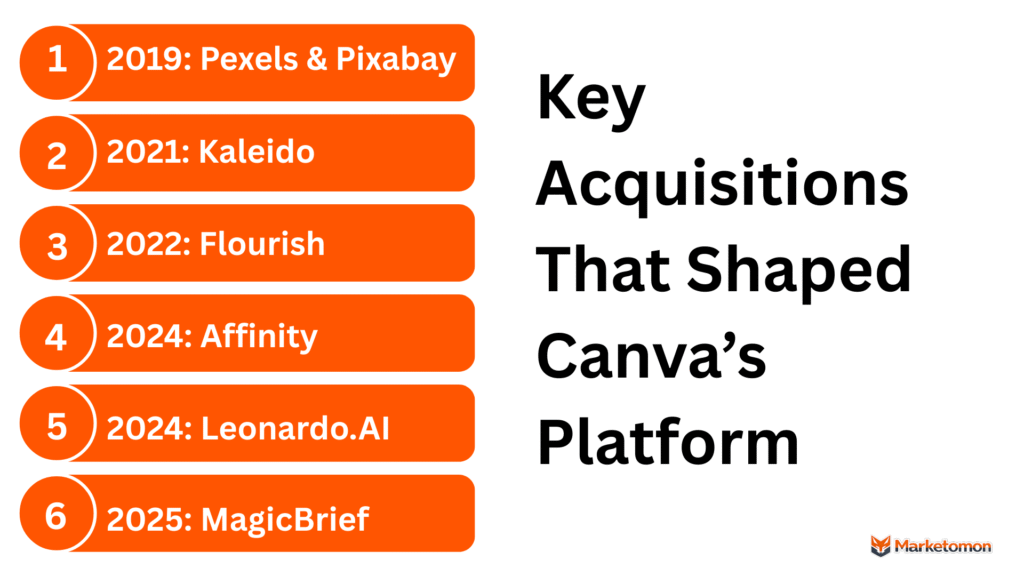
Content Expansion (2019)
- Pexels & Pixabay: Expanded stock photo library
Technical Features (2021-2022)
- Kaleido (2021): Enabled background removal tools
- Flourish (2022): Added data visualization capabilities (1 million users, 10+ million visualizations)
Professional Tier (2024)
- Affinity (2024): $380 million acquisition (estimated total value up to $1.35 billion) of a professional design suite
- October 2025 Game-Changer: Affinity made FREE FOREVER for all Canva users
- Instantly added 3 million professional users
- Direct challenge to Adobe’s professional tools
- Redesigned interface integrating vector, pixel, and layout tools
AI Capabilities (2024-2025)
- Leonardo.AI (2024): $320 million for generative AI capabilities, powering Dream Lab
- MagicBrief (2025): Integrated into Canva Grow, a full-stack marketing platform with ad analytics
These acquisitions demonstrate Canva’s strategy of expanding from a simple design tool to a comprehensive visual communication and marketing platform.
2025 Product Expansion: Beyond Design
In October 2025, Canva announced major product launches, transforming from a design tool into a creative operating system:
- Video 2.0: Complete video editing platform with TikTok/Reels templates, AI-powered edits, watermark-free outputs
- Canva Forms: Interactive data collection with direct Canva Sheets integration
- Canva Email Design: Visual email creation with AI-powered image generation, copy refinement, and one-click HTML export
- Canva Sheets: Spreadsheet with storytelling integration, data visualization, and widget creation
- Canva Code: App builder using natural language prompts (“vibe coding” for non-developers)
- Canva Grow: End-to-end marketing platform integrating MagicBrief analytics for performance measurement
These launches position Canva not as a design tool with features, but as a creative operating system that handles entire workflows from conception to deployment.
Programmatic SEO: Scaling Content at Massive Scale
Canva’s SEO strategy is one of the strongest growth levers behind its global visibility. Rather than relying on isolated blog posts, Canva built a systematic, programmatic content engine designed to capture demand at every stage of search intent. Canva avoids ranking for the wrong keywords by separating “template” and “create” pages, a common issue many sites face when pages rank for unintended keywords.
At scale, this approach has resulted in 24,000+ templated pages collectively driving tens of millions of organic visits each month.
Three Core Content Categories
1. Template Pages (/templates)
These pages target users seeking inspiration or ready-to-use designs, such as resume templates, certificate templates, and flyer templates. The depth is intentional. For example, the flyer category alone branches into dozens of subcategories like seasonal events, professional use cases, and niche occupations, each with its own dedicated page.
Result: The top-performing 16,500 template pages generate approximately 18.2 million organic visits per month.
2. Create Pages (/create)
Create pages that target users with a clear intent to design something themselves. Queries like “create a resume” or “design a certificate” signal action-oriented intent, which differs from template downloads. Canva separates these intents into distinct pages to maximize relevance and conversion.
Result: The top-performing 2,000 create pages drive about 8.5 million monthly organic visits.
3. Feature Pages (/features)
Feature pages highlight specific product capabilities, often aligned with emerging trends. During the rise of generative AI, Canva launched dedicated feature pages that captured high-intent searches and ranked quickly.
Result: Hundreds of feature pages contributing over 1 million organic visits per month.
SEO Performance Snapshot
The effectiveness of this system is reflected in how Canva ranks across high-volume design-related keywords:
| Keyword Category | Global Monthly Searches | Canva’s Ranking |
| graphic design | 539K | Top 3 |
| logo maker | 1.2M | #1 |
| poster design | 148K | #1 |
These rankings are not isolated wins but the outcome of a repeatable structure applied across thousands of pages.
Parent-Child Page Architecture
Canva uses a hierarchical page structure similar to large e-commerce platforms. Core category pages link to subcategories, which then link to highly specific pages. This setup strengthens internal linking, distributes authority efficiently, and helps search engines clearly understand topical relationships.
Example flow: Graphs → Bar graphs → Specific bar graph templates
Scalable Page Templates
Every programmatic page follows a consistent layout where only the keyword context changes across headlines, CTAs, and body content. This allows Canva to publish at scale without sacrificing structure or quality.
The benefits are operational as well as strategic: pages can be launched quickly, maintained efficiently, and optimized systematically when performance issues arise.
Global Localization Strategy
More than 65% of Canva users are non-English speakers, and the platform is available in over 100 languages. Their localization strategy goes far beyond simple translation.
Subdomain Strategy
Canva uses separate subdomains for different geographies (e.g., canva.com/es for Spanish), which:
- Improves SEO in local markets
- Provides culturally relevant content
- Ensures users find content in their language
Market Reach
- Available in 190+ countries (97.4% of the world’s nations)
- Supports 100+ languages
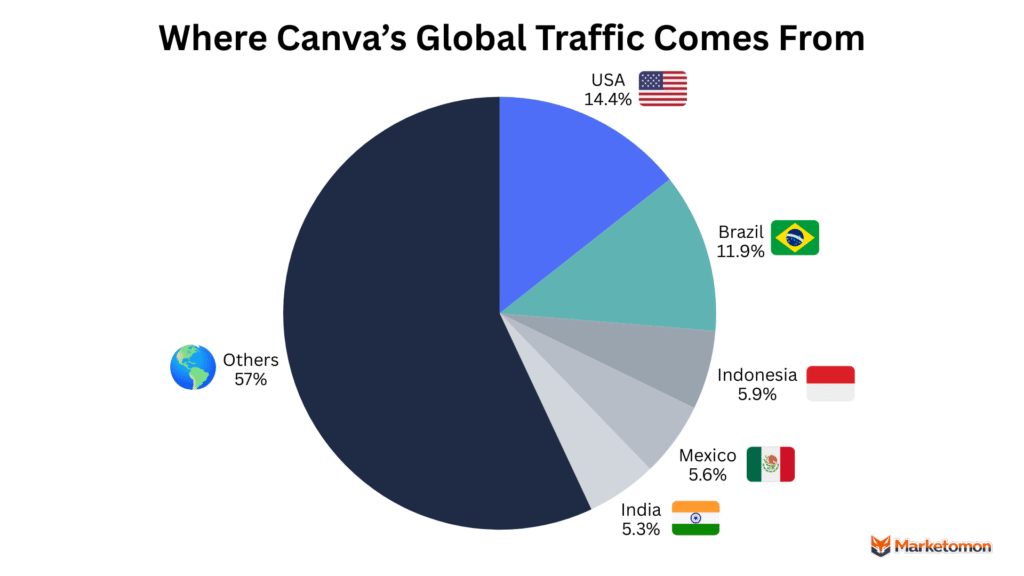
- The United States leads with 14.38% of traffic
- Brazil follows with 11.92% of traffic
- Indonesia secures 3rd spot with 5.9% of traffic
- Mexico contributes 5.57% of the total traffic
- India contributes 5.26%
- Other 56.96%
The company doesn’t just translate content – they adapt it for cultural relevance and local market needs, making Canva truly feel like a local product in each market.
User Demographics (2026)
Understanding Canva’s user base provides insight into their marketing effectiveness:
Age Distribution
- 18-24 years: 22% (second largest)
- 25-34 years: 31% (largest demographic)
- 35-44 years: 19%
- 45-54 years: 13%
- 55-64 years: 9%
- 65+ years: 6%
Key Insight: Over 53% of users are under 35, aligning with Canva’s mobile-first, template-driven approach.
Gender Distribution
- Female: 60%
- Male: 40%
(Female share increased from 55% in 2022 to 60% in 2025)
Device Usage
- Desktop: 60%
- Mobile: 40%
These demographics reveal Canva’s strong appeal to millennials and Gen Z users who value personalized, stylish products and are highly active online – a crucial insight for their marketing positioning and product development.
Content Marketing and Education
Design School
Canva invested heavily in educational content through their Design School platform, which offers:
- 100+ courses on design fundamentals to advanced techniques
- Tutorials for using Canva features
- Resources for marketing teams and SEO specialists
- Integrated with the freemium funnel to drive feature adoption
This serves multiple purposes:
- Provides genuine value to users
- Keeps users engaged with the platform
- Positions Canva as a thought leader in design
Canvassadors Program
The Canvassadors initiative turns expert users into teachers and content creators. These super-users can:
- Create and sell their own templates
- Teach courses through Canva
- Earn revenue through the Canva Creators program
- Build significant income streams through template sales and course creation
This creates a virtuous cycle: new users learn from Canvassadors, some become expert users themselves, and eventually become Canvassadors, bringing in more users.
Blog Content
Canva’s blog drives significant traffic with thousands of backlinks from authoritative sites. The content is organized into two primary categories:
Design-Related Content:
- Targeted at both beginners and experienced designers
- Leverages Canva’s design resources
- Attracts users looking to improve their skills
Marketing-Related Content:
- Aimed at marketing teams
- Covers topics from social media to content strategy
- Positions Canva as essential for marketing workflows
Strategic Link Building and Outreach
Unlike typical aggressive outreach campaigns, Canva takes a value-first approach to link building. Their team identifies bloggers and website owners who mention relevant topics like “digital marketing tools,” “invitations,” or “posters,” then reaches out to offer value.
The key differentiator: They don’t ask for links. Instead, they:
- Offer to create embeddable presentations
- Provide useful resources related to the content
- Build genuine relationships with content creators
This approach has helped Canva accumulate millions of backlinks from thousands of websites, with many leading to their programmatic SEO pages.
Affiliate Marketing Program
Canva runs an affiliate program where content creators and influencers:
- Promote Canva Pro on their platforms
- Earn commissions when users sign up through their links
- Create authentic content about Canva’s value
This expands Canva’s reach through trusted voices in various niches.
Social Impact and Brand Building
Canva’s mission extends beyond profit. By August 2024, they celebrated donating $1 billion worth of product value through:
Canva for Education
- Over 100 million students and teachers are using the platform (as of late 2025)
- Used in more than 800,000 schools across 16,000 school districts
- Most popular in the US, Brazil, and Mexico
- Free premium features for educational institutions
Canva for Nonprofits
- Supporting over 700,000 nonprofit organizations
- Free access to professional design tools
This commitment to social good strengthens brand loyalty and creates positive word-of-mouth marketing while genuinely helping communities that might not otherwise afford professional design tools. More importantly, it’s a long-term customer acquisition strategy: today’s students become tomorrow’s paying professionals.
Channel Strategy and Enterprise Focus
In May 2024, Canva initiated its first global channel strategy, focusing on reseller partners to expand in the enterprise market, particularly in regions where channel-based sales are prevalent, like Japan and Korea.
Direct Sales Channels
- Website and mobile apps (primary channels)
- iOS and Android applications
- Online marketplaces for template creators
Enterprise Growth
By late 2024, 95% of Fortune 500 companies were using Canva Teams, demonstrating successful expansion from consumer to enterprise market. The enterprise business has doubled, with multiple $1M+ deals signed.
Revenue and Growth Metrics (2026)
Canva’s revenue and user growth are best understood as outcomes of its marketing and distribution strategy, not isolated financial wins. Every major growth inflection aligns with expanded reach, improved onboarding, and stronger product-led acquisition.
Revenue Growth
| Year | Revenue | Year-over-Year Growth |
| 2016 | $4.4M | – |
| 2017 | $60M | 1,264% |
| 2018 | $84M | 40% |
| 2019 | $105M | 25% |
| 2020 | $500M | 376% |
| 2021 | $1B | 100% |
| 2022 | $1.7B | 70% |
| 2023 | $2B | 17.6% |
| 2024 | $2.7B | 35% |
| 2025 | $3.5B | 29.6% |
Revenue acceleration closely follows Canva’s expansion of freemium adoption, programmatic SEO, and global localization. Rather than relying on aggressive sales-led growth, Canva scaled revenue by increasing product exposure at the top of the funnel and allowing monetization to follow naturally.
User Growth
| Year | Monthly Active Users |
| 2014 | 600K |
| 2015 | 1.5M |
| 2016 | 3.6M |
| 2019 | 24M |
| 2020 | 40M |
| 2021 | 75M |
| 2022 | 100M |
| 2023 | 135M |
| 2024 | 220M |
| 2025 | 260M |
Each growth phase reflects a clear marketing lever:
- Early growth from ease-of-use and word-of-mouth
- Mid-stage acceleration from SEO and template discovery
- Recent scale from teams, enterprise adoption, and global reach
The product itself functions as the primary acquisition channel.
Paying Subscribers
- 2023: 16 million paying users
- September 2024: 21 million paying users
- 2025-2026: 27 million paying users (11-12% of total user base)
Engagement Metrics
- 30+ billion designs created since launch
- 38.5 million designs created daily
- 400+ designs created every second
- 12 designs are created every second in China alone
High creation volume reinforces Canva’s position in search, strengthens retention, and fuels organic sharing, turning user activity into a continuous marketing loop.
Employee Growth
- 2023: Approximately 4,000 employees
- 2024: 5,000 employees (1,128 hired in 2023, 500 in 2024)
- 2025-2026: 5,500+ employees globally
- Major offices in the US (Austin, San Francisco), London, Manila, Sydney, Wuhan, and Beijing
Valuation
- 2021: Peak valuation at $40 billion
- Current 2026 working valuation: $42 billion
- IPO Expected: 2026
Profitability
- Profitable since 2017 (first profitable year with 294K paying customers)
- Eight consecutive years of profitability as of 2025-2026
- Maintained profitability while achieving hypergrowth
- Enterprise business has doubled, with multiple $1M+ deals signed
Market Presence
- 95% of Fortune 500 companies use Canva
- 12.47% market share in the graphics market
- Drives over 260 million monthly website visitors
- Over 100 million visits from organic search alone
- Among the top 100 most visited websites in 61 countries
Market Positioning & Competitive Matrix
With Canva’s scale and growth established, its market position becomes clear when compared with other design platforms.
Canva does not compete solely on professional design depth. Instead, it is positioned as a mass-market visual communication platform built around ease of use, speed, and collaboration. This allows it to serve individuals, teams, and enterprises on a single platform.
Competitive Snapshot
| Platform | Monthly Active Users | Primary Focus | Strength | Limitation |
| Canva | 260M | Everyone | Simplicity, scale, collaboration | Less advanced controls |
| Adobe Express | 33M | Professional creators | Adobe ecosystem | Higher learning curve |
| Figma | 13M | Product teams | Design precision | Narrow use cases |
| VistaCreate | NA | Small businesses | Templates | Smaller ecosystem |
| PicMonkey | NA | Solo creators | Photo editing | Limited scope |
Strategic Positioning
Canva wins by reducing design friction. Templates, search-led discovery, and built-in collaboration make it accessible to non-designers while still valuable for teams. As organizations grow, Canva becomes a shared visual workspace rather than a specialist design tool.
Takeaway: Canva’s positioning is not about replacing professional tools, but about owning the largest possible design use case at scale.
Key Takeaways from Canva’s Marketing Strategy
1. Stop Selling Software, Start Selling Outcomes
Most SaaS companies are obsessed with listing features. Canva realized nobody wakes up thinking “I need vector editing capabilities.” They think, “I need to make a resume.” This sounds obvious, but go look at Adobe’s homepage – it’s still feature soup. Canva won by being the only one that actually got this.
2. One Template Is Content Marketing. 24,000 Templates Is a Weapon
Every marketing blog tells you to “create great content.” Canva ignored that advice and built a content assembly line instead. They don’t hand-craft blog posts – they generate thousands of SEO pages using templates. It’s not sexy, but it works. Most marketers won’t do this because it feels too mechanical. That’s exactly why it’s a moat.
3. “Freemium” Doesn’t Mean “Free Trial with Extra Steps”
Most companies sabotage their free tiers with annoying limitations to force upgrades. Canva did the opposite – they made the free version genuinely useful. The result? People actually recommend it. Crazy concept: if you’re not embarrassed by how much you’re giving away for free, you’re probably being too stingy.
4. Distribution Beats Innovation Every Time
Canva’s AI isn’t better than Midjourney or DALL-E. But putting it inside ChatGPT and Claude? That’s genius. Everyone’s focused on building the best AI. Canva focused on putting adequate AI where people already are. Lesson: Being in front of a billion users with a “good enough” product beats having the best product nobody knows about.
5. The Affinity Move Was Either Brilliant or Insane (Probably Both)
Spending hundreds of millions on professional design software, then giving it away for free, sounds like the dumbest business decision ever. Unless… you’re not selling software anymore. You’re selling collaboration, enterprise features, and ecosystem lock-in. Adobe sells seats. Canva sells workflows. That’s the difference.
6. User Intent Isn’t a Buzzword – It’s the Entire Strategy
“Resume template” and “create resume” feel like the same thing. They’re not. One person wants to download something. The other wants to make something. Canva built different pages for each. Most companies would just make one page and call it done. The discipline to segment this granularly is rare, and it’s why they dominate search.
7. Generosity Is a Growth Tactic (If You’re Patient Enough)
Giving away a billion dollars in free product to students and nonprofits looks altruistic. It is. It’s also brilliant marketing that won’t pay off for a decade. Most companies optimize for quarterly results. Canva planted seeds in 2015 that are bearing fruit now. The question: Do you have the patience?
8. SEO Architecture Matters More Than SEO “Content”
Everyone talks about “great content” for SEO. Nobody talks about information architecture. Canva’s parent-child page structure is borrowed from Amazon, not from content marketing blogs. The insight: SEO is an engineering problem dressed up as a writing problem. Treat it like product development, not a content calendar.
9. Your Product Should Market Itself (Literally)
“Made with Canva” on every design isn’t a feature – it’s forced virality. Canva baked attribution into the product itself. Every user becomes a billboard. Most products treat sharing as an afterthought. Canva made it unavoidable. If your product doesn’t naturally create awareness, you’re fighting uphill forever.
10. Don’t Add Features. Add Products.
Canva could have added video editing, forms, and spreadsheets as “features.” Instead, they launched them as separate products within one ecosystem. Why? Because “design tool with forms” sounds like feature creep. “Creative operating system” sounds like the future. Same capabilities, different framing, completely different market position.
The Uncomfortable Truth
Canva succeeded because it ignored conventional SaaS wisdom. No expensive sales team until they hit billions. No big marketing budget. No “growth hacking.” Just an annoyingly good product that spreads itself, wrapped in systems that compound over the years. The strategy is simple. Executing it for a decade without getting distracted? That’s the hard part most companies fail at.
Conclusion
Canva’s marketing strategy reveals a counterintuitive truth: the best marketing feels invisible.
There are no Super Bowl ads. No celebrity endorsements. No massive paid acquisition budgets. Instead, Canva built a self-reinforcing system where:
- SEO answers questions users are already asking
- Freemium converts curiosity into loyalty
- AI makes every design better than the last
- Social impact creates tomorrow’s customers today
The numbers validate the approach: $3.5B in revenue, 260M users, 27M paying subscribers, and eight consecutive years of profitability – all while giving away professional tools to 100 million students and 700,000 nonprofits.
As Canva prepares for its 2026 IPO with groundbreaking integrations into ChatGPT and Claude, the strategy remains unchanged: remove friction from creativity.
The lesson for marketers: Build systems that compound, not campaigns that expire. Canva didn’t outspend Adobe – they out-systematized them.
With the recent decision to make Affinity free forever and the launch of the Canva Design Model, the company isn’t just competing in the design software market – they’re redefining what a creative operating system looks like.
If Melanie Perkins’s track record holds, public markets will soon discover what 240 million users already know: when you make design this accessible, growth becomes inevitable. The question for the next decade isn’t whether Canva will grow, but whether it can maintain this strategy as it enters the public markets, where quarterly growth often trumps long-term system building.
If history is any guide, bet on Melanie Perkins staying the course.



I don’t know whether it’s just me or if everybody else encountering problems with your blog.
It looks like some oof the text within your content are running off
the screen. Can somebody else plewase commnt and let me know if this is happening to them as well?
This could be a issue with my browser because I’ve hhad this happen before.
Thanks
Hi, thanks for pointing that out. We checked the page on our end and everything appears to be displaying correctly. It may be related to a browser, zoom, or device-specific issue. Could you let us know which browser and device you’re using? That will help us investigate further. We appreciate your feedback.